How to Get Rid of Geese (And Keep Them Off Your Lawn)
Contents[hide]
- 1. Why Geese Pick Your Yard
- 2. Goose Control and the Law
- 3. How to Get Rid of Geese, Step by Step
- 3.1. Step 1: The Most Effective Way to Keep Geese Away Is Taller Grass
- 3.2. Step 2: Install a Physical Barrier
- 3.3. Step 3: Remove Food Sources and Clean Up Goose Droppings
- 3.4. Step 4: How to Scare Geese Away With Visual Deterrents
- 3.5. Step 5: Auditory Deterrents (Noise and Motion)
- 3.6. Step 6: Goose Repellents
- 3.7. Step 7: Trained Dogs
- 4. When to Call a Professional
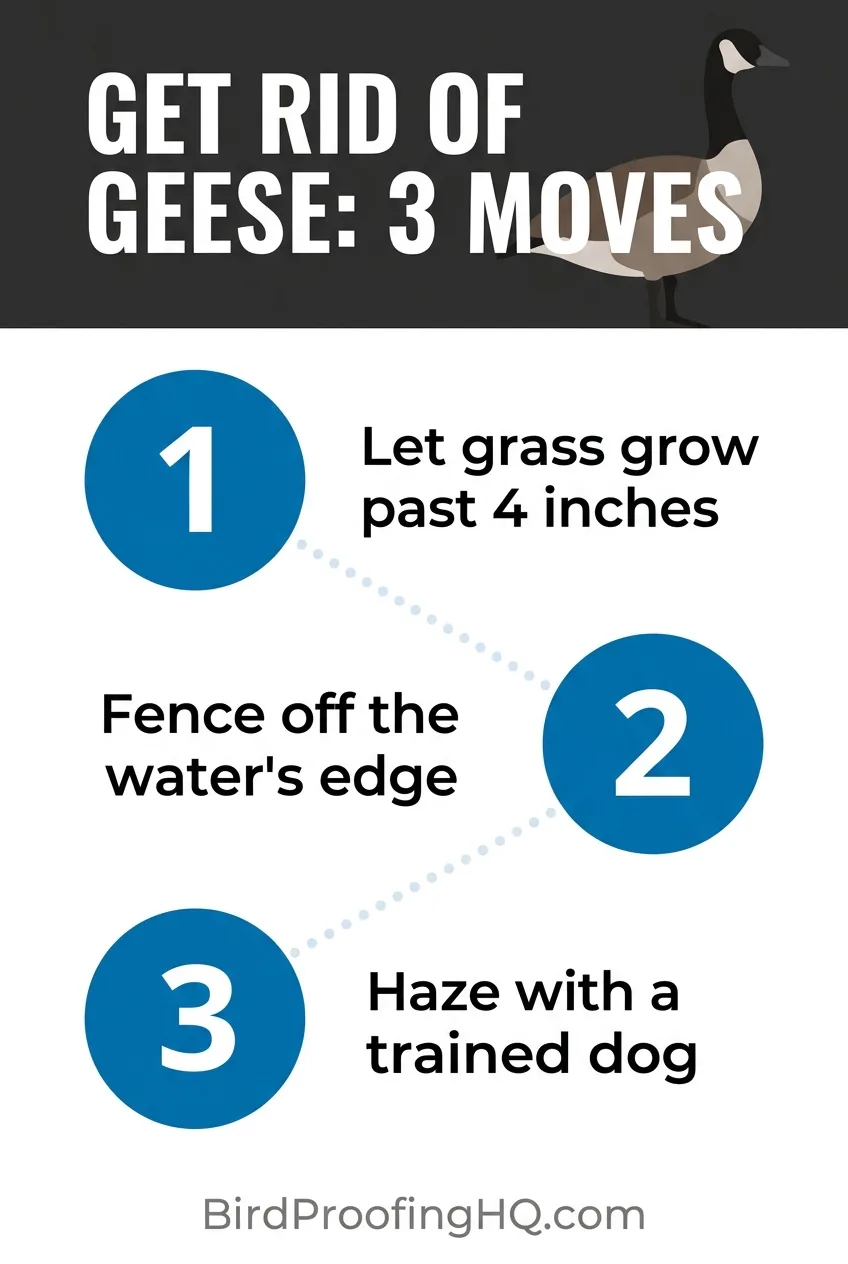
To get rid of geese, let your grass grow past 4 inches and put a low barrier between any water and your lawn. Canada geese graze short turf and feel exposed in tall grass, so those two changes remove their main reasons for staying. If geese are already established, a trained Border Collie is the most effective legal, humane option.
In this article, we’ll cover how to get rid of Canada geese without breaking federal law, which habitat changes work, and the hazing tactics that actually hold.
Why Geese Pick Your Yard
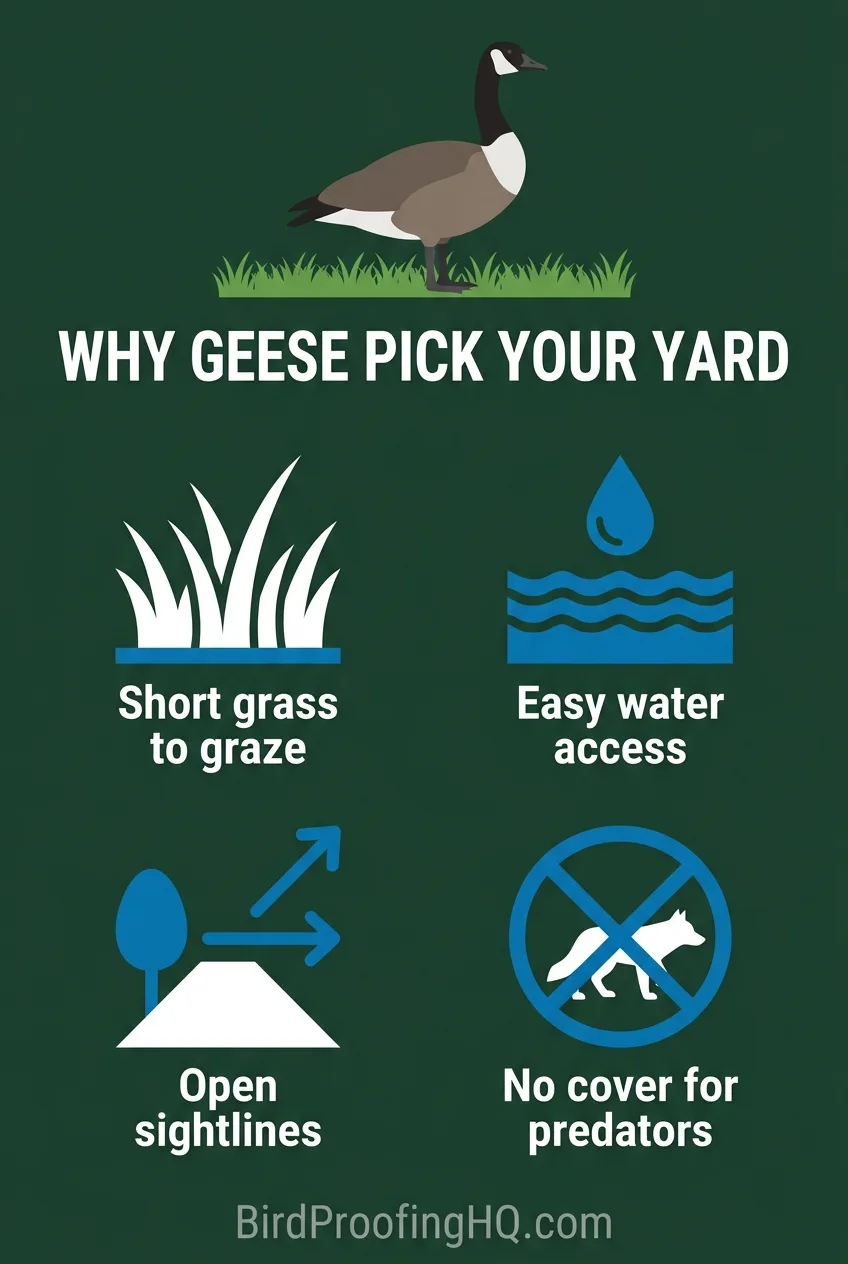
Geese want three things: short grass for grazing, water access, and open sightlines to spot predators coming. Suburban yards mowed short next to ponds, golf courses, and parks hit all three. Remove any one of them and the yard stops appealing to geese before they ever settle in. It helps to know whether you are dealing with resident or migratory Canada geese, because that changes the plan.
Resident Canada geese are birds that adapted to suburban habitat and stopped migrating. They are increasingly common, and they cause most year-round goose conflicts. Migratory birds pass through seasonally. A resident flock will use the same pond and yard every day of the year if conditions stay good.
Resident Canada geese also nest earlier and defend their nests more fiercely than migratory birds. An aggressive pair with eggs will claim a surprising radius around the nest.
During the summer molt, adult geese drop their flight feathers and cannot fly for several weeks. So a flock that settles in June is guaranteed to still be there in July.
Geese also show strong site fidelity. Flocks that nested or grazed on your property in prior years will return the following season, often with their young. Canada geese pose a real cleanup problem at that point. A single goose produces a pound or more of droppings a day, and a dozen geese will carpet a yard in a week.
That is why breaking the pattern early matters more than any single deterrent if you want to keep geese away long term. Plenty of owners try one gadget, fail, and conclude you cannot get rid of resident flocks. You can; it just takes layers.
Goose Control and the Law
Canada geese are fully protected under the Migratory Bird Treaty Act. So legal goose control comes down to what you may and may not do:
- Legal without a permit: hazing (chasing geese off without harm), trained dogs, habitat modification, goose repellents, and any deterrents that scare geese rather than injure them. You can legally chase geese off your lawn every single day.
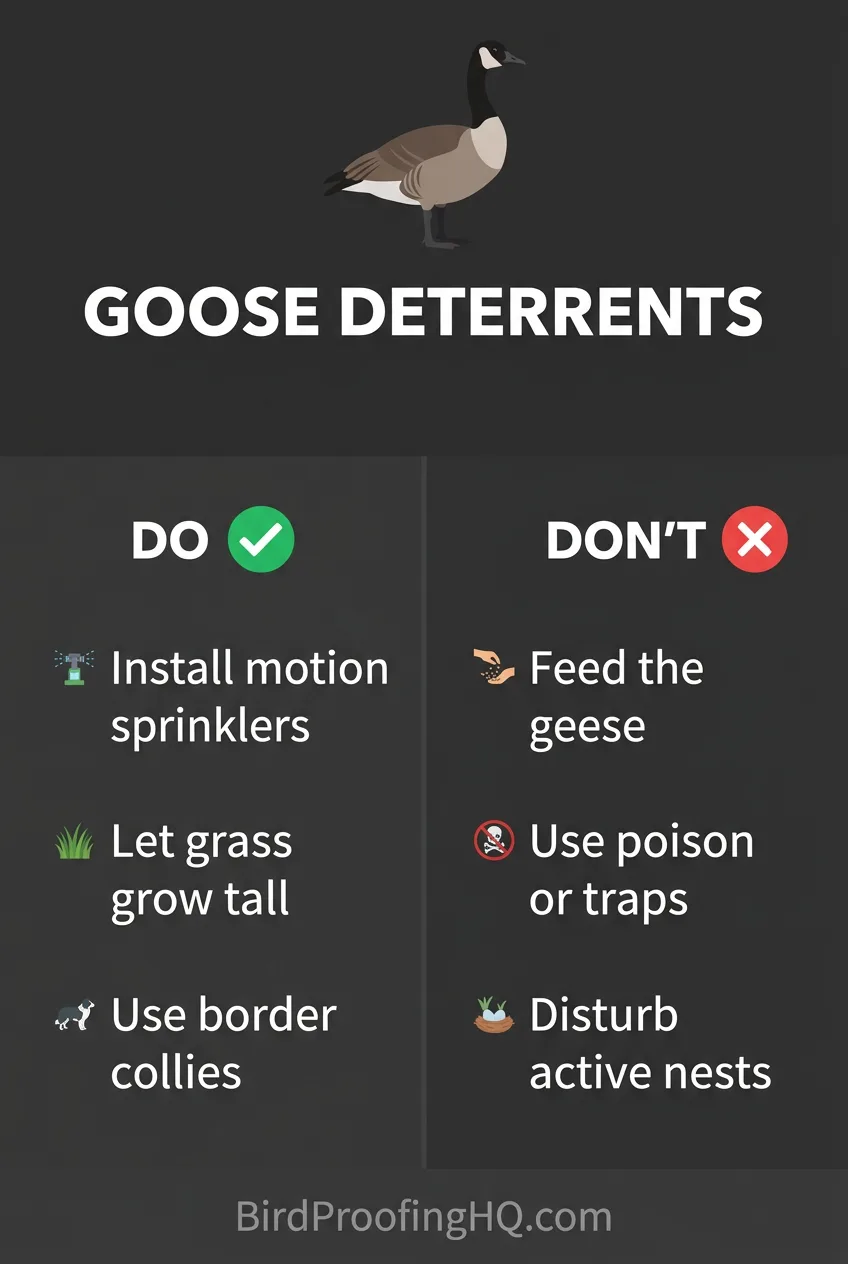
- Requires a federal depredation permit: egg oiling or addling to stop eggs from hatching, destruction of nests, and lethal removal. Wildlife agencies treat Canada geese nests and eggs as strictly off limits without that paperwork. Permits are granted when humane methods have been exhausted and there is documented damage or a safety concern for humans.
- Never legal: harming adults, young, or eggs without that permit.
If geese are nesting on your property and the nest has to go, contact your local USDA Wildlife Services office. Disturbing an active nest yourself can carry federal penalties. The well being of the goslings is the government’s stated priority in how these permits get decided.
How to Get Rid of Geese, Step by Step
Work these in order. Each step makes the next one bite harder.
Step 1: The Most Effective Way to Keep Geese Away Is Taller Grass
This is the single most effective change for most property owners. Canada geese prefer turf around 2 to 3 inches for grazing. The birds feel exposed in tall grasses because height limits their ability to spot predators.
Let the grass grow to 4 to 6 inches in the areas where geese graze. You do not need to let the whole yard go wild, just the zones where the geese concentrate. Many owners switch those zones to tall fescue, which geese dislike compared to Kentucky bluegrass. The area stops being a buffet and starts being cover.
Taller grass also reads, to a goose, like a place predators could hide. Few changes deter geese as cheaply as mowing less.
If you have waterfront, let the shoreline vegetation grow to 2 to 3 feet and stop mowing it. A strip of tall grasses, native plants, and shrubs along the water eliminates the easy water-to-lawn transition that geese depend on. Dense shrubs and aquatic plants at the water’s edge work even better. Geese avoid walking through vegetation they cannot see over.
If you want it tidy, structured beds of tall plants do the same job as wild growth.
Step 2: Install a Physical Barrier
A fence between water and your yard is the most reliable goose deterrent for properties near ponds or lakes. Geese walk onto lawns from the water rather than flying in, so a barrier along the edge breaks their access pattern.
The barrier does not need to be tall. A fence of 2 to 3 feet is enough, because geese prefer to walk onto feeding areas. A knee-high string or wire fence, a low garden fence, or even a line of stakes with rope between them will discourage geese.
It will not stop other wildlife. But it keeps geese off the lawn reliably, all season, with zero maintenance.
Position the barrier right at the water’s edge rather than further into the yard. Geese that cannot walk onto the lawn typically move on to other areas rather than fly over a short fence.
Step 3: Remove Food Sources and Clean Up Goose Droppings
Geese stay where the eating is good, so cutting off food matters just as much as the rest.
Stop feeding the geese. Feeding geese on purpose, by anyone, is the fastest way to draw them. It makes every other method less effective. Geese that link people with bread will put up with an astonishing amount of hazing.
Clean up spilled birdseed under any bird feeders. Geese happily graze the ground under feeders, and spilled birdseed is a food source most people never think about.
Regularly clean up goose droppings from walkways, docks, and patios. Beyond the health and mess issues, droppings signal to passing flocks that other geese feed here safely. A clean yard reads as unclaimed territory.
Reduce standing water where you can. Geese use ponds and wet low spots for drinking, bathing, and raising goslings. Drain what can be drained. Cover small decorative ponds with netting during peak season, which keeps geese out and protects your fish and plants too.
Between mowing habits and food sources, you control most of what makes a yard attractive to Canada geese.
Step 4: How to Scare Geese Away With Visual Deterrents
Visual deterrents deter geese by convincing the birds the area is full of predators. The goal is to scare geese away before they land, not after. The cardinal rule: move everything regularly, because geese figure out static props fast.
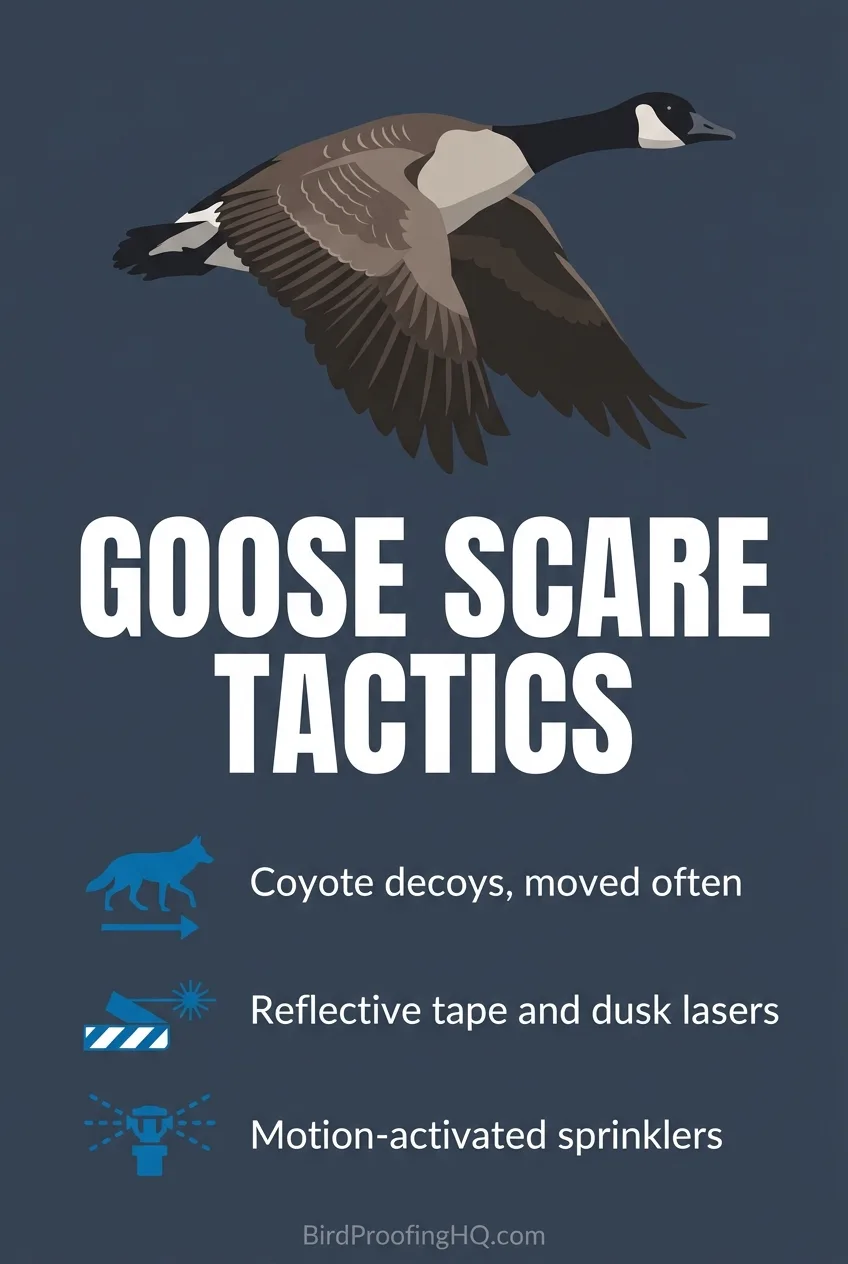
Coyote decoys are the classic choice, and they exploit the goose’s most feared land predator. Position coyote decoys where geese can see them from the water and the air. Move them every two to three days. A decoy that never moves stops scaring geese within about a week, and they walk right past it. Dead goose decoys and realistic predator silhouettes work the same way.
Reflective objects add another layer. Mylar flags, reflective tape, and flashing lights create unpredictable movement and glare that geese find unpleasant at feeding sites. Hang strips at fence height along the water’s edge or wherever the flocks gather. That keeps geese off their favorite feeding zones.
Laser deterrents used at dusk are effective for moving nighttime roosts off ponds and lakes. Point the beam near the birds, not directly at them. The moving dot reads as a predator, and the geese leave the water. Few tricks scare geese away from a night roost faster.
Step 5: Auditory Deterrents (Noise and Motion)
Sound adds pressure on top of visual methods, and the combination outperforms either alone. Auditory deterrents lose their power fastest of all the options, so rotation matters most here.
Noise making devices such as distress call players and propane cannons work best at irregular intervals. Loud noises on a fixed schedule become background sound to geese within days, so vary the timing and move the device. Recordings of goose distress calls and predator sounds both discourage geese effectively.
Motion activated sprinklers startle geese with a burst of water whenever geese or other animals enter the coverage zone. They run automatically, cover a defined area, and double as irrigation. For most suburban yards they are the best set-and-forget option to keep geese off a specific zone.
Chase geese on sight in the early days of an occupation. Walking briskly toward the flock, clapping, or using an air horn is legal, humane hazing, as long as no goose is touched. Consistency matters more than intensity. Geese leave properties where every visit gets interrupted, and this kind of hazing breaks no law.
Step 6: Goose Repellents
Methyl anthranilate (MA) is the active ingredient in every goose repellent worth buying. It is a grape-derived compound that irritates birds when they graze treated turf. It makes the lawn taste wrong without harming the geese, pets, or humans.
Commercial chemical repellents like Flight Control Plus and ReJeX-iT are sprayed onto the lawn and reapplied after heavy rain or mowing. Apply before the geese establish a feeding pattern. A flock that already considers your yard home will test a treated lawn for days before giving up. Used with taller grass, repellents stop geese from re-establishing a feeding pattern, and they are among the few products that work on stubborn flocks.
For most situations they are a supporting layer on top of habitat changes, not a standalone fix. Goose repellents like Flight Control Plus and ReJeX-iT are compared in detail if you want to go deeper on specific products and reapplication timing. A natural bird repellent covers the wider, cross-species options.
Step 7: Trained Dogs
For a persistent goose infestation, a trained Border Collie is arguably the most effective humane tool in existence. The dogs haze the flocks by approaching, circling, and pursuing without making contact. This mimics real predator pressure, and Canada geese that face it daily abandon the site within days to weeks. Nobody gets hurt, and the geese do not come back.
Professional goose management companies use trained Border Collies on golf courses, corporate campuses, and residential properties. Many offer scheduled visits rather than a permanent dog on site.
If you have your own dog, know that untrained chasing is less effective than trained herding. Random pursuit teaches the geese that the dog is a nuisance, not a threat. Trained herding teaches them the property has a predator that never loses interest.
During nesting season, keep any dog away from nests entirely. Protective geese will stand their ground, and an aggressive goose defending eggs can injure a dog.
When to Call a Professional
Most residential goose problems respond to habitat modification plus consistent hazing within a few weeks. Call a professional wildlife management company in a few cases: a large flock settled in year-round, nests in multiple spots, or a commercial property, park, or other public space. They bring trained dogs, commercial-grade goose control gear, and the permits for addling eggs and removing nests once humane methods alone have not worked. A good company will also tell you how to keep geese away after they leave.
Getting rid of geese is mostly patience and layers. The earlier you act, the easier it is to stop geese from claiming the place at all. For methods that work across species, a few bird deterrents round out the toolkit.
If geese are nesting this season, treat it as a nesting problem where timing is set by law for protected birds. And for what the flock leaves behind, bird poop cleanup handles it.
Ducks are the geese’s close cousins and respond to many of the same tactics. If both have moved in, getting rid of ducks covers the pool and yard angle. And if geese are just one of your bird problems, the bird-by-bird hub covers every species.
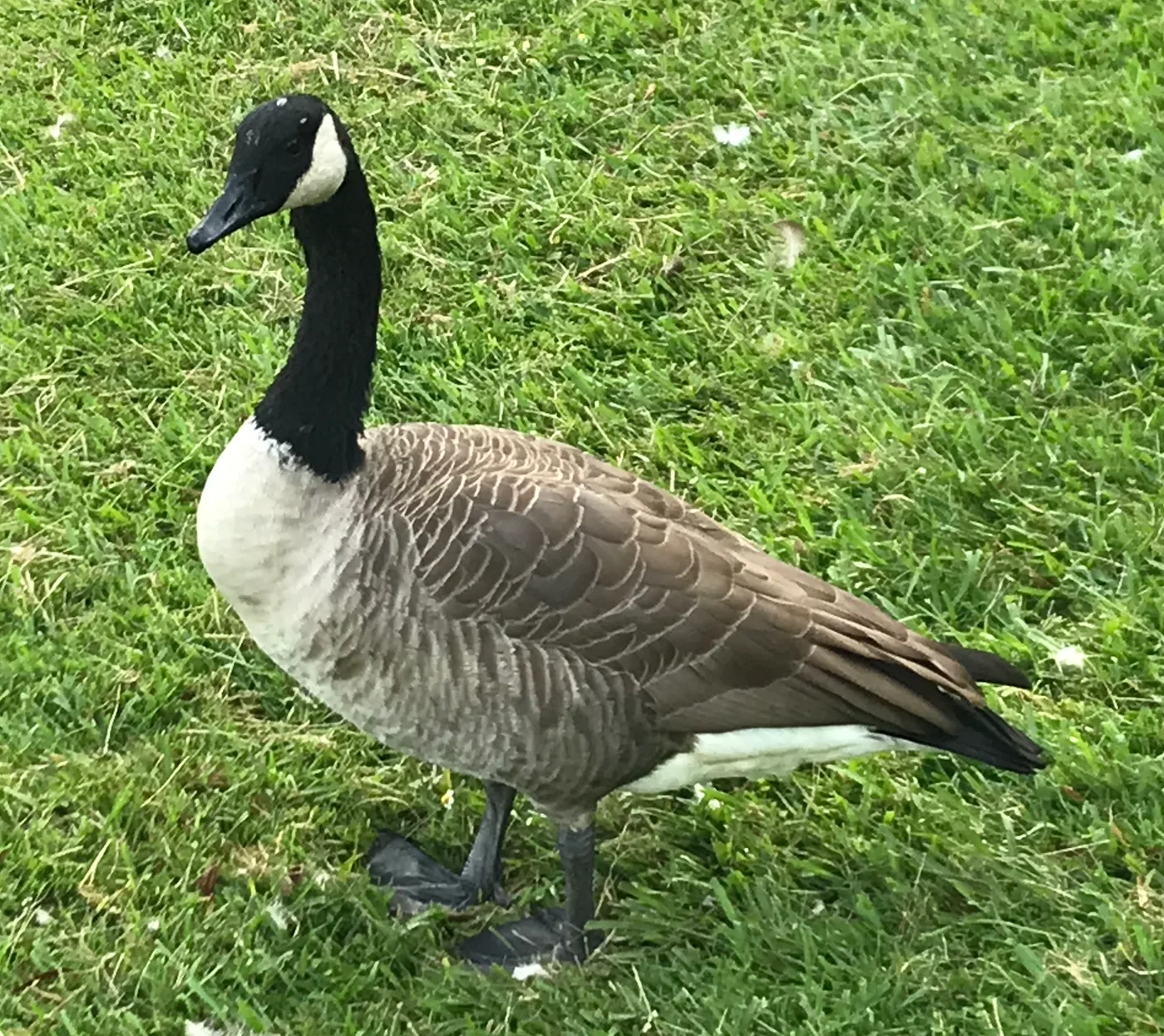
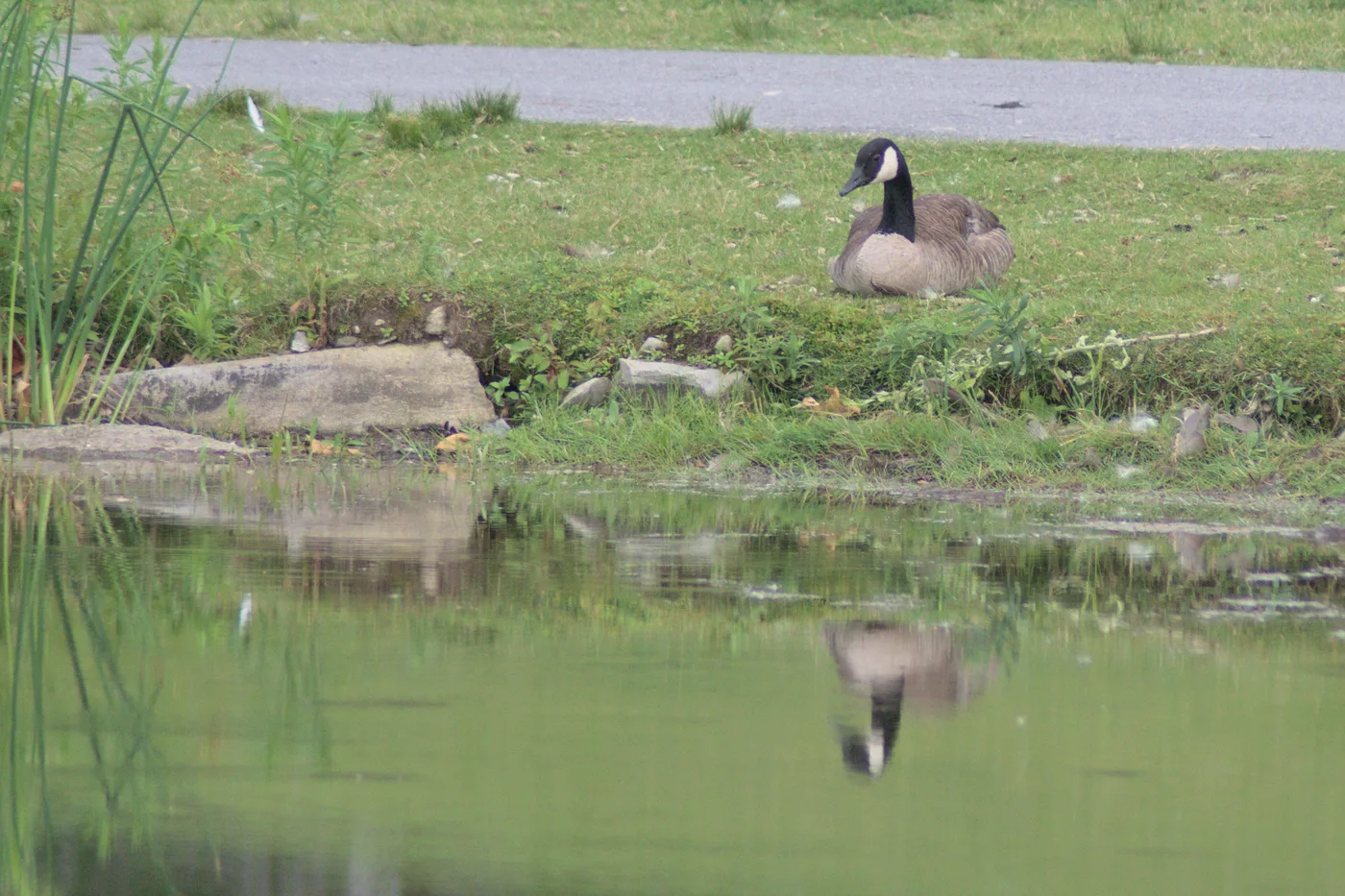
Images: Canada goose on grass by Qwertyxp2000, CC BY-SA 4.0. Canada goose beside a pond by devyn.barrie, CC0. Both via Wikimedia Commons. Infographics by BirdProofingHQ.


Free: The 5-Step Bird-Proofing Checklist
Work through the right steps in the right order, before spending money on the wrong deterrents. Printable PDF, straight to your inbox.
No spam. Unsubscribe any time.