How to Get Rid of Sparrows (8 Humane Methods That Work)
Contents[hide]
- 1. Why House Sparrows Keep Coming Back
- 2. How to Get Rid of House Sparrows, Step by Step
- 2.1. Step 1: Change Your Bird Feeders
- 2.2. Step 2: Switch the Seed You Feed Wild Birds
- 2.3. Step 3: Block Nesting Sites
- 2.4. Step 4: Remove Nests Promptly
- 2.5. Step 5: Trap Persistent House Sparrows
- 2.6. Step 6: Visual Deterrents at Problem Spots
- 2.7. Step 7: Protect Native Birds and Their Nest Boxes
- 2.8. Step 8: Work With Your Neighborhood
- 3. When to Call a Professional
To get rid of house sparrows, switch to safflower or nyjer seed, use caged or short-perch feeders they cannot use, and block nesting sites before spring. Those three changes stop most sparrow problems. Check state and local rules before removing an active nest or trapping.
In this article, we’ll cover how to get rid of sparrows legally, why their invasive status matters, and how to protect the native birds they displace.
Why House Sparrows Keep Coming Back
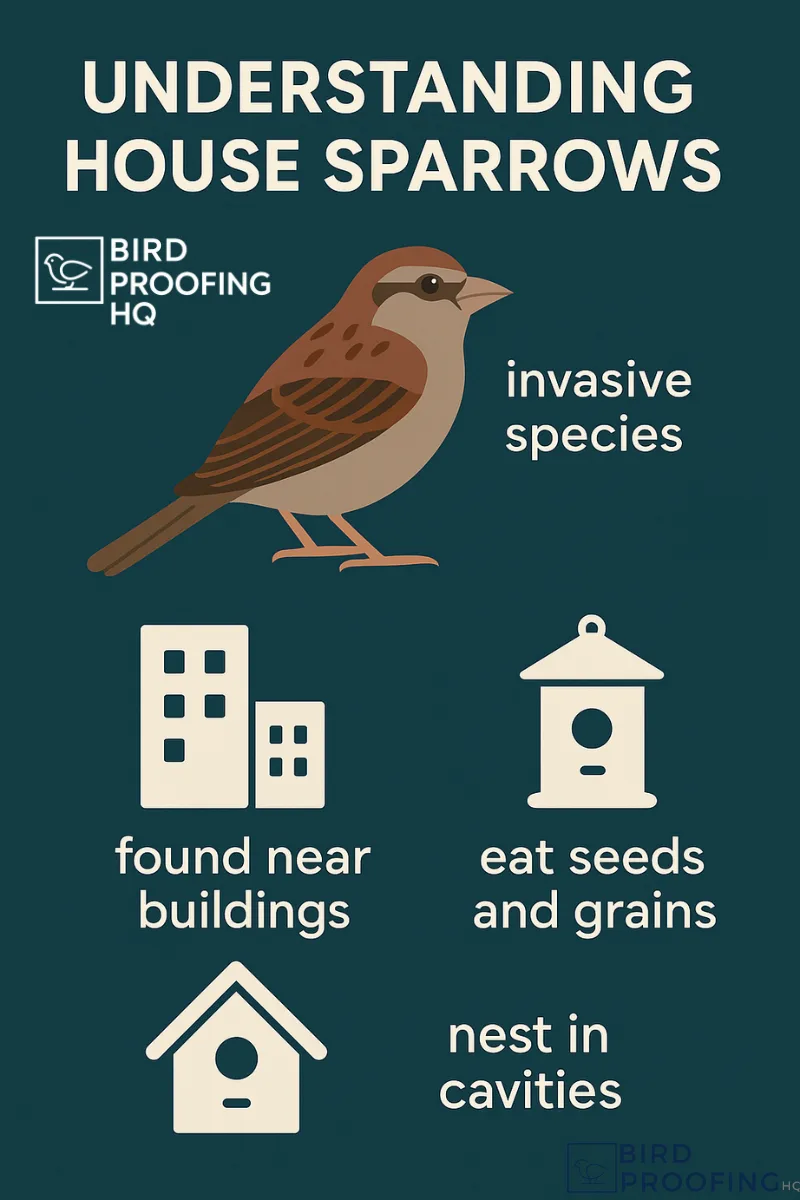
House sparrows evolved near human settlements in Europe, and your backyard offers exactly what they are built to exploit: food, cavities for nesting, and shelter from predators. They do not need wild habitat. The closer your property is to buildings, eaves, gutters, and dense shrubs, the more it draws them. A thriving local population can build up within a few seasons.
None of this means giving up on feeding wild birds. It means feeding them smarter.
At feeders, they go for cracked corn, millet, white bread scraps, and black oil sunflower seeds. If that food is available, sparrows find it fast, then nest within a short fly of the feeding station. They also eat insects during breeding season. A backyard that offers both food and nesting sites creates a feedback loop.
More food draws more birds, more birds hatch more young, and the neighborhood population grows every year. The link between feeders and nesting is direct, which is why food comes first.
Note the timeline before you start: nothing here works overnight. Plan on two to three weeks of consistent effort before the sparrows take the hint and move on. Basically, you are slowly convincing the birds that your yard no longer works for them.
How to Get Rid of House Sparrows, Step by Step
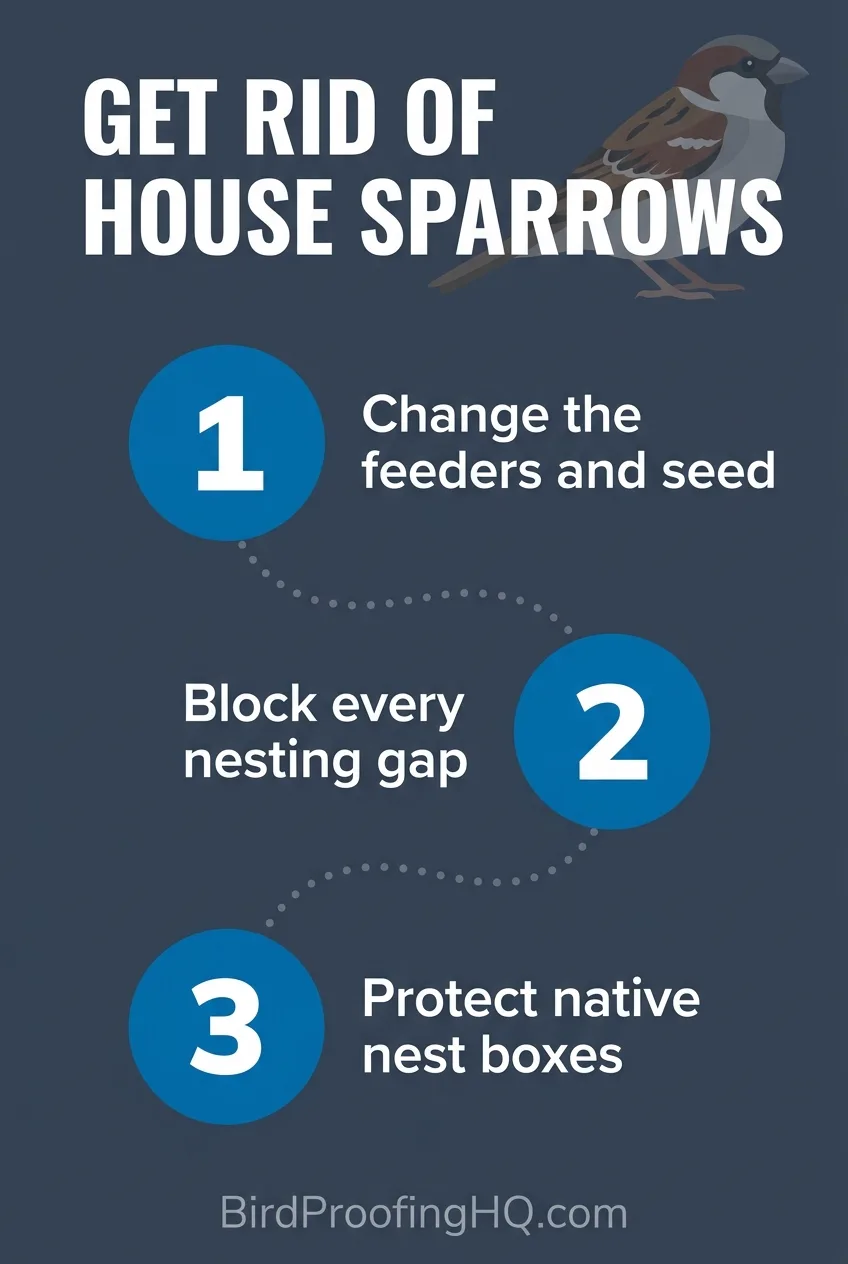
Work these in order. Each one makes your yard less worth a sparrow’s time.
Step 1: Change Your Bird Feeders
The feeder type matters as much as what you put in it. They are stocky birds that prefer stable platforms they can sit and eat from comfortably. The right feeder design makes feeding difficult for them while leaving other wild birds unaffected.
Tube feeders with short perches work because house sparrows struggle to hold position on small perches while feeding. American goldfinches and chickadees do this easily. The birds attempt it a few times and eventually give up.
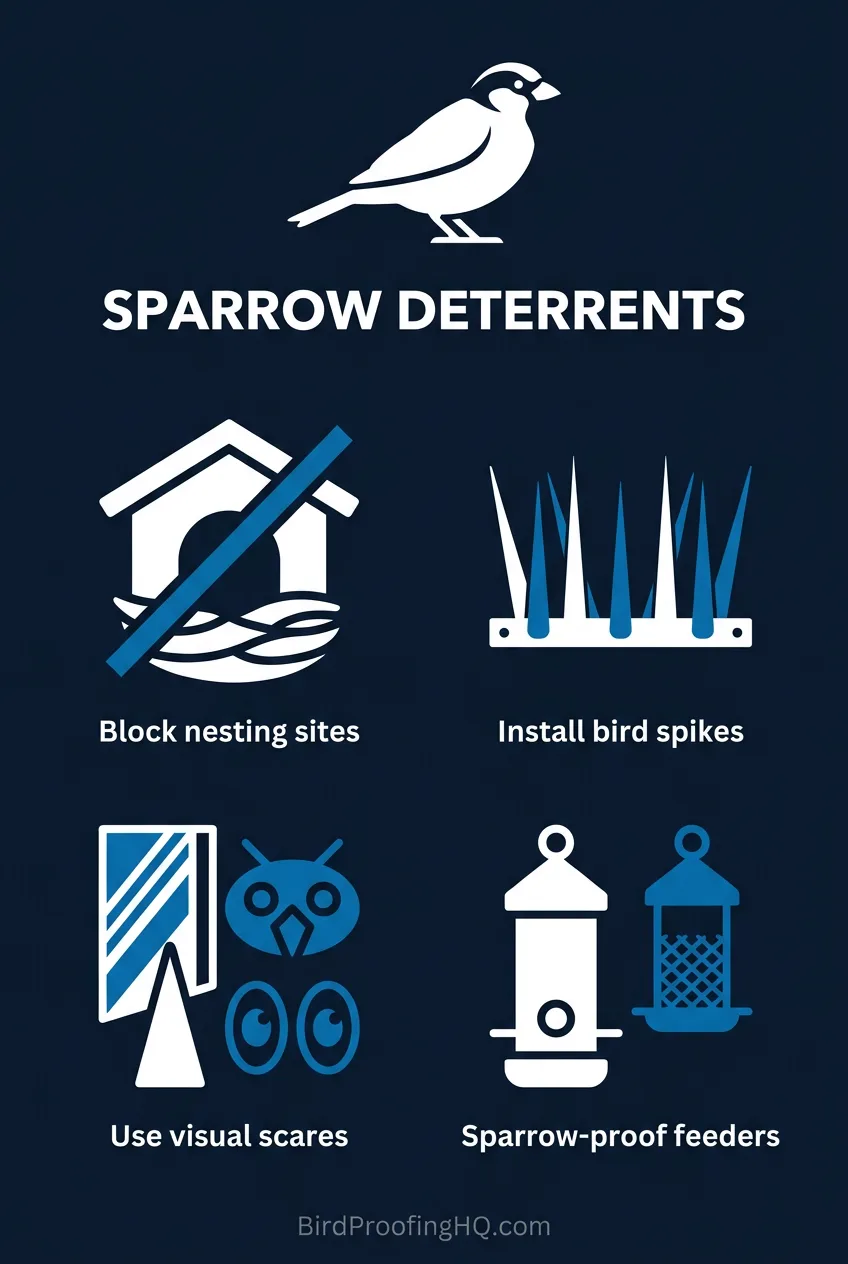
Caged feeders with a cage diameter of around 11 inches allow smaller birds through while blocking house sparrows and starlings. This is the most reliable exclusion method if you want to keep a mixed-species feeding station running.
Upside-down suet feeders are especially effective. Suet is the block of fat you hang out for woodpeckers and other clingers. Woodpeckers, nuthatches, and chickadees take it comfortably upside down. Sparrows cannot manage it and abandon those suet feeders within days. Standard suet cages, by contrast, get dominated by sparrows and starlings.
Remove large platform feeders and hopper feeders if sparrows are dominating. Both designs provide the flat, stable surface house sparrows prefer, and both spill seed onto the ground below, which feeds the rest of the flock. One feeder type that needs no change: hummingbird feeders. Sparrows ignore nectar, so your hummingbirds are safe throughout all of this.
Step 2: Switch the Seed You Feed Wild Birds
What you put in the feeder has as much impact as the design. They strongly prefer corn, millet, and bread scraps. Cutting these supplies from your feeding routine immediately makes your backyard less attractive. That is the link most people miss: seed choice drives everything else.
Safflower seeds are the most effective swap. House sparrows dislike the bitter taste and largely avoid safflower, while cardinals, chickadees, and house finches eat it readily. You keep feeding the wild birds you want while pushing sparrows to look elsewhere in the neighborhood.
Nyjer (thistle) seed in tube feeders with small ports is another strong option. Goldfinches and siskins pull it through the small ports easily, but house sparrows mostly cannot, so they give up and move on.
Also clean up spilled seed from the ground under feeders. They forage on the ground just as readily as at feeders, and spilled seed draws them first. That layer under the feeder often becomes their main source, even after you change the feeder itself. If you hope to starve them out while still feeding everyone else, ground cleanup is the step most people skip.
Step 3: Block Nesting Sites
Sparrows nest in any cavity available: vents, eaves, gaps in siding, the open ends of gutters, and nest boxes. Blocking access before breeding season (April through July) beats dealing with active nests. A female with an established nest will defend it stubbornly.
Screen vents and eaves with half-inch hardware cloth. Attach it securely around any opening larger than about an inch. Cut each piece so it overlaps the hole edges by an inch or two on every side. Pay particular attention to exhaust vents, ridge vents, and any gap at roof edges.
Seal gaps in siding and fascia. Walk the perimeter of your house in early March, spot every hole a small bird could squeeze into, and caulk or close it.
Keep garage and shed doors closed. If you leave them open for ventilation, add a strip of mesh across the opening to block birds without blocking airflow.
Step 4: Remove Nests Promptly
Because house sparrows are not protected by the Migratory Bird Treaty Act, you can remove their nests, eggs, and nesting materials without a permit. Prompt removal is the surest fix for a specific problem spot.
Remove nests as soon as you notice them being built. The sooner you act, the less established the birds become. Wear gloves, since sparrow nests often carry mites. Throw the material away in a sealed bag.
If you drop it on the ground nearby, the pair will just recycle it.
For nest boxes, check weekly during breeding season. If sparrows have taken over a box intended for bluebirds, remove the sparrow nest and eggs immediately. Left in place, house sparrows will break bluebird eggs and kill nestlings.
Removing the sparrow nest is the more humane outcome for the native birds. Wait them out: expect the pair to rebuild once or twice before they eventually quit, because persistence wins within a couple of weeks.
Step 5: Trap Persistent House Sparrows
When exclusion and feeder changes are not enough, trapping is the next step and is legal in most states. Two trap categories matter:
In-box traps mount inside a nest box that sparrows are claiming. The Van Ert trap is the best known: it snaps a wire across the entrance hole when the bird enters, holding it inside unharmed. The elevator trap is the other classic in-box design, lowering the bird into a holding chamber. Both catch the problem bird at the exact site it is defending, which makes them the most targeted trap option for protecting nesting bluebirds.
Repeating ground traps are larger cage traps baited with millet or cracked corn. They can catch many birds in a day, and the rest of the flock still flies in to check the bait. They work best placed near the feeding areas the birds already use. Check any trap at least twice daily, and release native species at once and unharmed. A trap is only as kind as the person running it.
A note on what comes after. Wildlife rehabilitators and bluebird groups recommend humane euthanasia for trapped house sparrows, not relocation. Relocated sparrows either come back or dump the problem on someone else’s nest boxes.
If you are not prepared for that step, focus on exclusion instead. It is legal too, and trapping just demands more thought before you start.
Step 6: Visual Deterrents at Problem Spots
For locations where you want to deter house sparrows from returning after exclusion:
Sparrow spooker: a small device mounted above a nest box after a native bird has established its nest. It unfurls reflective Mylar strips that wave in the breeze. House sparrows avoid the movement while the resident bird habituates and continues nesting normally. These are inexpensive and specifically designed for bluebird box protection.
Reflective tape hung near eave openings and vent covers adds visual disruption that makes those areas feel unsafe. Move it every few days to prevent habituation.
Predator decoys near known nesting areas help discourage return visits, especially with reflective deterrents alongside. A stationary decoy stops working within a week, so move it regularly. A repellent spray does little to house sparrows next to physical and visual methods. Spend your money on hardware first, not on a natural repellent that other species respond to better.
Step 7: Protect Native Birds and Their Nest Boxes
If you keep nest boxes, the entrance hole size is the simplest way to exclude house sparrows while welcoming native wild birds.
Bluebird houses use a 1.5-inch entrance hole. House sparrows can squeeze through the same opening. To keep sparrows out while bluebirds are nesting, add a Noel guardian, a wire cage extension at the entrance. A PVC pipe entrance works too.
Both make it harder for sparrows to get in, and impossible for them to perch at the hole and harass the birds inside.
Wren boxes and chickadee boxes with a 1.25-inch hole shut out house sparrows entirely, so smaller species get safe housing by design. Mount boxes on a smooth metal post, not a tree or fence. Add a baffle so raccoons and cats cannot reach the box. Place them at least 300 feet from buildings where sparrows gather.
Song sparrows and chipping sparrows, the native species, are not the target of any of this and coexist fine.
Keep up the weekly checks described in Step 4. Give native birds a fair chance to hatch their broods. That is the single best thing you can do for the cavity nesters on your property.
Step 8: Work With Your Neighborhood
House sparrows operate at the community scale, not the single-backyard scale. If the neighbors three doors down keep an open platform feeder stocked with bread scraps, your flock has a fallback the moment you tighten up.
You do not need to organize the whole community. One conversation with the closest feeding households, a shared link, and agreement on safflower over millet covers most of it. Bluebird trail volunteers see the same pattern with boxes.
Where several households run sparrow-resistant nest boxes, fledge rates climb and wild birds reclaim territory. One unmanaged box two yards over keeps the local sparrows in steady nursery space.
This is also where expectations matter. You will not eliminate house sparrows from the neighborhood; there are too many and they breed too fast for that hope to be realistic. What you can absolutely do is make your own backyard, feeders, and boxes a place where they no longer thrive.
When to Call a Professional
For small-scale sparrow problems at feeders and nest boxes, consistent DIY methods work well. Sometimes house sparrows nest inside a building structure in large numbers. A pest control company that handles bird exclusion can assess the entry points, install commercial-grade mesh, and run a trapping program to cut the population. For farm settings where sparrows or starlings damage crops, your local USDA Wildlife Services office can advise on management options.
To move problem birds along without driving away the ones you enjoy, a few bird deterrents help. If sparrows are getting into specific structures, treat it as a nesting problem, where timing matters and the law differs for protected species. And if starlings are in the mix too, the other unprotected invasive responds to the same playbook.
For every other species we cover, start at the how to get rid of birds hub.
Images: Photo by Marshall Patterson on Unsplash. Infographic by BirdProofingHQ.
Free: The 5-Step Bird-Proofing Checklist
Work through the right steps in the right order, before spending money on the wrong deterrents. Printable PDF, straight to your inbox.
No spam. Unsubscribe any time.